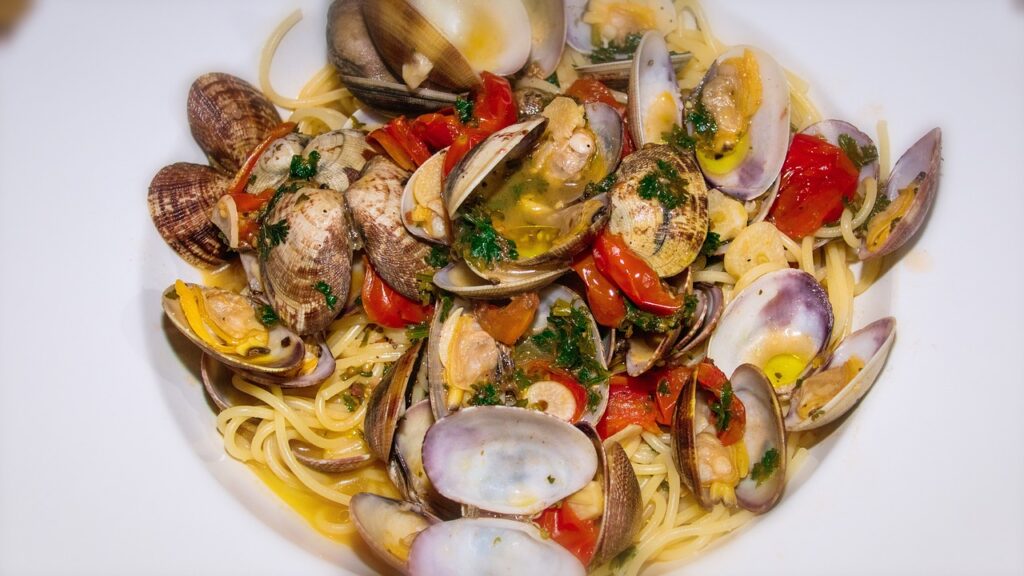
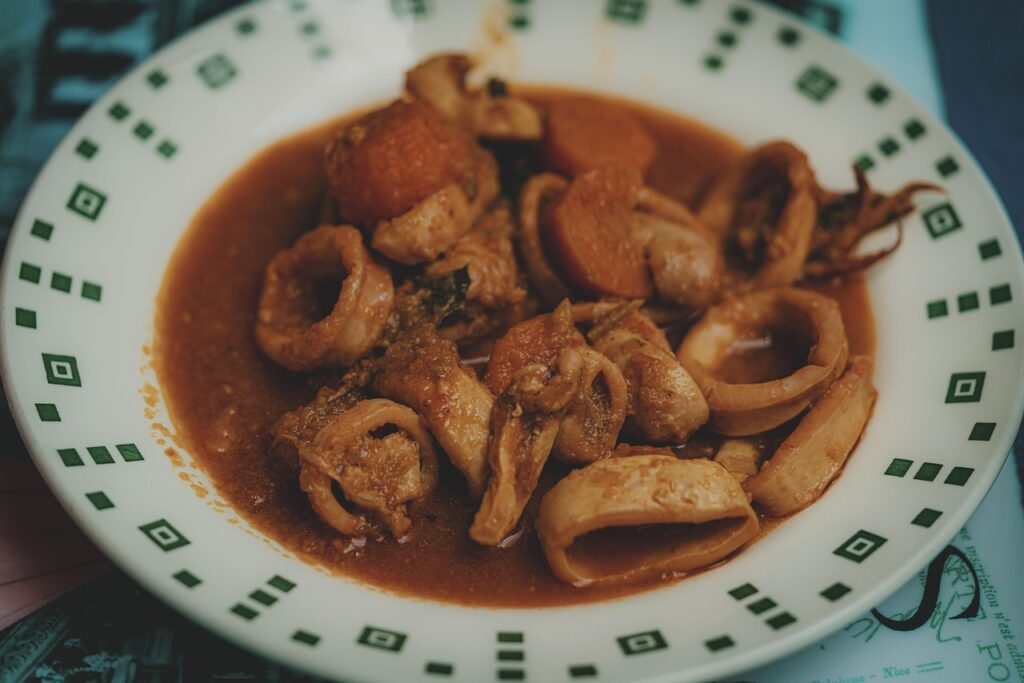
Cacciucco is Livorno’s great fish dish: a thick stew of many kinds of fish, molluscs and shellfish, cooked in tomato with garlic, sage and chilli and served over slices of toasted bread rubbed with garlic. It began as a poor dish, made with the low-value fish left over from the catch, and is eaten as a meal in itself.
In this article you’ll find quantities for 6 people, which fish to choose, a stock made from heads and bones, the order in which to add fish and shellfish, the story of the name, practical tips, variations and how to store it.
Recipe card
| Item | Detail |
|---|---|
| Preparation | 1 hour |
| Cooking | 1 hour 30 minutes |
| Resting | None |
| Total time | 2 hours 30 minutes |
| Difficulty | Medium |
| Servings | 6 people |
| Category | Fish one-dish meal |
| Cuisine | Tuscan (Livorno) |
| Cooking method | Stewing |
Ingredients for 6 people
For the cacciucco
- 500 g octopus
- 500 g cuttlefish
- 300 g smooth-hound (palombo) or another firm-fleshed fish, in steaks
- 500 g soup fish (gurnard, scorpionfish), scaled and cleaned
- 500 g crustaceans (mantis shrimp, prawns, langoustines)
- 500 g mixed mussels and clams, cleaned and purged
- 400 g sieved peeled tomatoes
- 1 tablespoon tomato paste
- 200 ml dry white wine
- 3 garlic cloves
- 5 sage leaves
- 1 fresh or dried chilli
- 120 ml extra virgin olive oil
- 1 handful chopped parsley
- Salt and black pepper, to taste
For the fish stock
- Heads and bones from the soup fish
- 1 celery stick, 1 carrot, 1/2 onion
- 1.5 l water
To serve
- 12 slices stale Tuscan bread
- 2 garlic cloves
The fish. Cacciucco is made with the day’s catch, so the quantities are a guide. What matters is the mix of families: molluscs (octopus and cuttlefish), soup fish that are bony but full of flavour (gurnard, scorpionfish), a firm-fleshed fish that holds together (smooth-hound), crustaceans and shellfish. Have your fishmonger clean the fish and ask them to keep the heads and bones for you.
The bread. You need stale Tuscan bread, toasted and rubbed with garlic: it goes in the bottom of the bowl and soaks up the sauce without falling apart.
How to make cacciucco alla livornese
- Make the stock. Put the heads and bones in a pot with the celery, carrot, onion and cold water. Bring to the boil and simmer gently for 30 minutes, then strain and keep the stock hot.
- Cut the fish. Cut the octopus into pieces and the cuttlefish into strips, and the smooth-hound and soup fish into 4-5 cm chunks. Wash the mussels and leave the clams to purge in salted water.
- Make the base. In a wide, shallow pan, ideally terracotta, warm the oil with the crushed garlic, sage and chilli over a low heat for 2-3 minutes, without letting the garlic brown.
- Cook the octopus and cuttlefish. Add the octopus and cuttlefish, let them take on flavour for 5 minutes, pour in the wine and let it evaporate. Add the tomato paste dissolved in a ladle of stock and the tomatoes, salt lightly and cook covered over a low heat for 40-50 minutes, adding stock if the sauce dries out, until the octopus and cuttlefish are tender.
- Add the fish. Lay the smooth-hound and soup fish in the pan, pour in a couple of ladles of stock and cook for 15 minutes without stirring: shake the pan to stop it sticking, so the pieces stay whole.
- Finish with crustaceans and shellfish. Add the crustaceans and after 3-4 minutes the mussels and clams. Cover and cook for 5-7 minutes, until the shells open. The result should be a thick stew, not a thin soup. Season with salt and pepper and finish with parsley.
- Toast the bread and serve. Toast the bread slices on a grill or in the oven and rub them with garlic. Put two in the bottom of each bowl and pour the fish and sauce over them. Serve at once.
History and tradition of cacciucco
Cacciucco belongs to the Tuscan coast and especially to Livorno, where it is spelled with five Cs; further north, towards Viareggio and the Lucca area, it is also called “caciucco”. It began as a dish of fishermen and poor families, who put together the less valuable fish left unsold. One tradition says it should contain at least five kinds of fish, one for each C in the name.
The origin of the name is uncertain: the most frequently cited theory links it to a Turkish word meaning a mixture of small pieces, fitting for a dish made from many different fish. Cacciucco also appears in Pellegrino Artusi’s cookbook, which suggested using whatever fish you have to hand and serving it with slices of bread.
Practical tips
- The order of cooking. The key is to add the fish according to cooking time: molluscs first, then fish, and crustaceans and shellfish last.
- Don’t stir. Once the fish is in, shake the pan instead of using a spoon: the pieces stay whole.
- The stock makes the difference. Stock from heads and bones gives the sauce a taste of the sea that water can’t. Add it a little at a time.
- Well-toasted bread. Soft bread falls apart in the sauce: it must be stale and toasted.
- Wine at the table. In Livorno cacciucco is often served with a young red wine, even though it is a fish dish.
Variations and storage
Variations
Every family and every trattoria has its own version, because the fish changes with the market. Instead of smooth-hound you can use conger eel steaks or another firm-fleshed fish; squid can partly replace the cuttlefish. If you prefer a dish that is easier to eat, use filleted fish instead of fish on the bone, bearing in mind the sauce will have less flavour.
Storage
Cacciucco is best freshly made. Leftovers, without the bread, keep in the fridge in a sealed container for one day and are reheated gently with a ladle of stock. Leftover fish stock can be frozen for a month. Prepare the bread just before serving.
Frequently asked questions about cacciucco
Which fish go into cacciucco?
Molluscs such as octopus and cuttlefish, soup fish such as gurnard and scorpionfish, a firm-fleshed fish such as smooth-hound, crustaceans such as mantis shrimp and prawns, and shellfish such as mussels and clams. The choice depends on the day’s catch.
Why is cacciucco spelled with five Cs?
It is the Livorno spelling of the name. According to a popular tradition, the dish should contain at least five kinds of fish, one for each C.
Is cacciucco a soup?
It is more of a fish stew than a soup, with a thick sauce that soaks the bread. It is served in a bowl and eaten as a meal in itself.
Can it be made ahead?
The stock and the base with octopus and cuttlefish can be made ahead and kept in the fridge until the next day. The fish, crustaceans and shellfish should be added only shortly before serving.
More soups and recipes from the Tuscan coast
From the Versilia coast comes scarpaccia, a sweet zucchini tart. Among the soups of inland Tuscany you’ll find acquacotta, farro soup and ribollita. To discover Tuscan cooking at the stove, Orto San Frediano’s cooking classes in Florence are a good place to start.