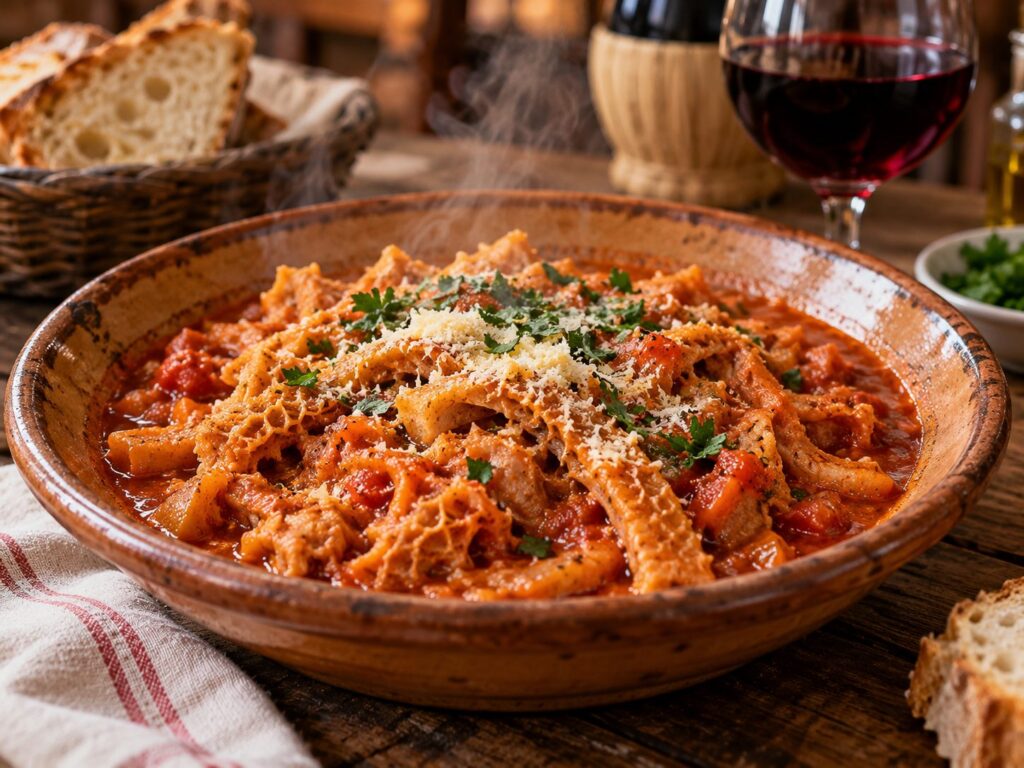
Peposo is a beef stew from Impruneta, just outside Florence, cooked very slowly in red wine with black peppercorns, garlic and salt. It uses no soffritto and no tomato: the wine and the long cooking turn a cut rich in connective tissue into soft, dark, aromatic meat with a thick, peppery sauce.
In this article you’ll find the peposo recipe for 4 people, with the cut of meat to choose, the amount of pepper, stovetop or oven cooking, the history linked to the kiln workers of Impruneta, practical tips and the most common variations.
Recipe card
| Item | Details |
|---|---|
| Preparation | 20 minutes |
| Cooking | 4 hours |
| Resting | 10 minutes |
| Total time | 4 hours 30 minutes |
| Difficulty | Easy |
| Servings | 4 people |
| Category | Meat main course |
| Cuisine | Tuscan |
| Cooking method | Stewed, on the stovetop or in the oven |
Ingredients for 4 people
- 1.2 kg beef shin (shank or fore shin)
- 750 ml Chianti red wine
- 6 garlic cloves
- 15 g black peppercorns
- Freshly ground black pepper, to taste
- Fine salt, to taste (about 10 g)
- 4 slices of Tuscan bread to serve
The meat. You need a slow-cooking cut rich in collagen, such as shin or shank. During the hours in the wine the collagen melts, making the meat tender and the sauce thick. Lean cuts such as topside or silverside stay dry and stringy.
The pepper and the wine. Black peppercorns are the seasoning that gives the dish its name: they release aroma and heat gradually as they cook. The traditional wine is Chianti, enough to cover the meat. A good Tuscan red makes a difference, because it is not diluted with any other liquid.
How to make peposo
- Cut the meat. Remove the thickest pieces of fat but leave the marbling and connective tissue. Cut the shin into pieces of about 4 cm, roughly the size of a large walnut.
- Prepare the aromatics. Peel the garlic cloves and leave them whole or lightly crushed. Coarsely crush half the peppercorns in a mortar and leave the rest whole. For a milder dish, tie the whole peppercorns in a piece of muslin to remove at the end.
- Fill the pot. Place the meat in a terracotta pot or a heavy-based casserole, add the garlic and pepper and pour in the wine until the meat is covered. No oil is needed: the meat cooks in the wine and its own fat.
- Start cooking. Bring to a gentle boil over medium heat, then turn the heat to the minimum, ideally with a heat diffuser. Cover with the lid, leaving a small gap.
- Cook slowly. Simmer for about 4 hours, stirring every 30-40 minutes. The liquid should barely tremble. If it reduces too much too early, add a little wine or hot water. Alternatively, cook in a conventional oven at 150 °C (300 °F), covered, for the same time.
- Salt halfway through. After about 2 hours, taste the liquid and add salt. Salting later avoids an over-salty sauce, as the wine concentrates.
- Check the texture. Peposo is ready when the meat falls apart under a fork and the sauce is dark, reduced and thick. If it is still runny, remove the lid and continue for 15-20 minutes.
- Serve. Turn off the heat, rest for 10 minutes, finish with freshly ground pepper and serve on slices of toasted Tuscan bread to soak up the sauce.
History and tradition of peposo all’Imprunetina
Peposo is linked to Impruneta, the town south of Florence known for its terracotta, from bricks and tiles to large pots. According to local tradition it was created by the fornacini, the kiln workers, who cooked meat with wine and pepper in terracotta pots near the mouths of the kilns, using the heat of the long firings. This is why the dish is also called peposo alla fornacina.
A famous name is also associated with peposo. The story goes that Filippo Brunelleschi, who went to Impruneta to oversee the production of terracotta for Florence Cathedral, enjoyed this dish of the kiln workers. It is a handed-down tale rather than a documented fact.
One explanation offered for the generous use of pepper and wine is that they helped mask the taste of meat that was not always very fresh: this too is a hypothesis. The traditional recipe has been set down in a production protocol listing beef, Chianti wine, peppercorns, garlic and salt as ingredients, with no tomato.
Practical tips
- Use a terracotta or cast-iron pot. They spread heat evenly and keep a steady low temperature, the key condition for tender meat.
- Don’t rush. Turning up the heat to save time toughens the fibres. If the meat isn’t falling apart after 4 hours, keep cooking: the time depends on the cut and the size of the pieces.
- Adjust the pepper to your taste. 15 g gives a bold dish. For a gentler version use 8-10 g of peppercorns, keep them whole and tie them in muslin.
- Make it the day before. Like many stews, peposo improves after a night in the fridge: the flavours come together and the fat on the surface is easy to remove.
Variations and storage
Variations
Many home recipes add a little tomato paste or passata, which makes the sauce redder and less acidic: it is a common variation but not part of the traditional recipe. Other versions add a sprig of rosemary or a few sage leaves.
Some cooks brown the meat in a little oil before adding the wine, for a more roasted flavour, and some marinate it in the wine overnight before cooking. Besides toasted bread, peposo is often served with mashed potatoes, polenta or a side of beans.
Storage
Peposo keeps in the fridge, in a sealed container, for 3 days. Reheat it over low heat with a spoonful of water or wine. It can be frozen with its sauce for 2-3 months; thaw it in the fridge before reheating.
Frequently asked questions about peposo
What is the best cut of beef for peposo?
Beef shin, fore or hind, and shank are the most suitable cuts because they contain collagen that melts during cooking. Cheek and chuck also work well. Avoid lean roasting or steak cuts.
Does peposo contain tomato?
Not in the traditional Impruneta recipe: the ingredients are beef, wine, pepper, garlic and salt. Tomato appears in many home and restaurant versions, but it is a later addition.
Can I cook it in a pressure cooker?
Yes, in about 1 hour 15 minutes once at pressure, but the result is different: the wine reduces less and the sauce stays thinner. At the end, reduce the liquid with the lid off for 15-20 minutes.
Which wine goes with peposo?
The same wine used for cooking is the most consistent choice: a Chianti or another Sangiovese-based Tuscan red with good acidity, which balances the richness of the sauce and the heat of the pepper.
What to serve with peposo
A classic side for peposo is fagioli all’uccelletto, beans with garlic, sage and tomato. In the colder months you can serve a ribollita before it. If you’d like to get to know traditional Florentine dishes and their cooking times first-hand, the cooking classes at Orto San Frediano in Florence are a good place to start.