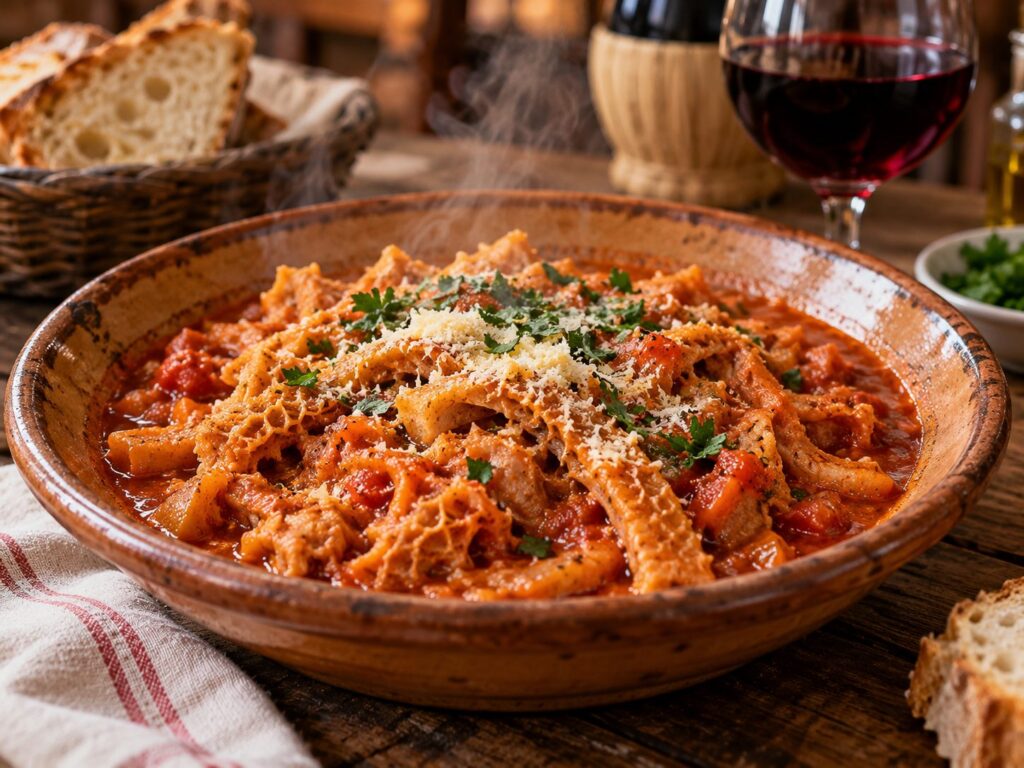
Pappa al pomodoro is a Tuscan soup made with stale bread, ripe tomatoes, garlic, basil and extra virgin olive oil. The bread cooks in the tomato sauce and broth until it breaks down completely, giving a thick, rustic cream: the right consistency is that of a “pappa” (a mash) that holds on the spoon, not a liquid soup.
In this article you’ll find the original recipe for 4 people, with precise quantities, cooking times, tips for using fresh or canned tomatoes, mistakes to avoid and the traditional ways to serve it: hot, warm or at room temperature.
Recipe card
| Item | Details |
|---|---|
| Prep time | 15 minutes |
| Cooking time | 35 minutes |
| Resting time | 15 minutes |
| Total time | 1 hour 5 minutes |
| Difficulty | Easy |
| Servings | 4 people |
| Course | First course |
| Cuisine | Tuscan |
| Cooking method | In a pot, on the stove |
Ingredients for 4 people
- 300 g stale Tuscan bread (unsalted, 2-4 days old)
- 800 g ripe tomatoes (or 800 g canned peeled tomatoes out of season)
- 750 ml hot vegetable broth
- 2 garlic cloves
- 15 fresh basil leaves
- 60 ml extra virgin olive oil for cooking
- 4 tablespoons raw extra virgin olive oil, to serve
- Fine salt, to taste (about 4 g)
- Ground black pepper, to taste
The bread. Unsalted Tuscan bread breaks down evenly and doesn’t alter the seasoning of the dish. A bit of crust is fine too: it softens as it cooks and gives body to the soup.
The tomatoes. In summer, use ripe, flavourful tomatoes such as ribbed or San Marzano varieties. For the rest of the year, good-quality canned peeled tomatoes give a more consistent result than out-of-season fresh tomatoes.
How to make pappa al pomodoro
- Peel the tomatoes. If using fresh tomatoes, score a cross in the skin and plunge them into boiling water for 1 minute, then into cold water. Peel them, remove the most watery seeds and chop them. If using canned tomatoes, crush them roughly with a fork.
- Prepare the bread. Cut the bread into thin slices or 2-3 cm pieces. There is no need to soak it: it will soften directly in the pot.
- Flavour the oil. In a heavy-bottomed pot, warm the oil over low heat with the crushed garlic cloves for 2 minutes. The garlic should only just turn golden: if it burns, the soup will taste bitter.
- Cook the tomatoes. Add the tomatoes, a pinch of salt and half the torn basil. Cook over medium-low heat for 15 minutes, stirring occasionally, until the sauce has reduced slightly. Remove the garlic if you prefer a milder flavour.
- Add the bread and broth. Add the bread and pour in the hot broth a little at a time. Cook over low heat for about 20 minutes, stirring often with a wooden spoon or a whisk and pressing the bread against the sides of the pot, until it has completely broken down.
- Check the consistency. The soup is ready when it is thick and creamy: a spoon drawn across the bottom should leave a trail that closes slowly. If it is too dry, add a ladle of broth; if it is too runny, keep cooking for a few more minutes.
- Rest and serve. Turn off the heat, add the remaining basil, adjust the salt and pepper, cover and leave to rest for 15 minutes. Serve in bowls with a drizzle of raw extra virgin olive oil.
History and tradition of pappa al pomodoro
Pappa al pomodoro comes from Tuscan peasant cooking, where bread was baked once a week in the home oven or the village oven and had to last until the next batch. The hardened bread became the base for soups like this one, flavoured with olive oil, herbs from the garden and, in the summer months, tomatoes.
Its fame outside Tuscany is largely due to Vamba’s children’s book Il Giornalino di Gian Burrasca, published in instalments between 1907 and 1908: the young hero, at boarding school, protests against bland soups with the cry “Viva la pappa col pomodoro”. The slogan became popular again in 1964 with the RAI television series based on the book, in which Rita Pavone sang the song written by Lina Wertmüller and Nino Rota.
In Tuscany, pappa al pomodoro is eaten hot in winter and warm or at room temperature in summer. Tradition says no cheese should be added.
Practical tips
- Use a heavy-bottomed pot. The bread tends to stick: a thin base and high heat are the most common causes of burnt soup.
- Heat the broth before adding it. Cold broth slows down cooking and the bread breaks down less evenly.
- Balance the acidity. If the tomatoes are very acidic, add a pinch of sugar or cook the sauce for 5 minutes longer before adding the bread.
- Don’t blend it. A stick blender gives a smooth, gluey cream; the traditional texture is rustic, with the bread broken up by hand.
- Let it rest. After resting, the flavours come together and the soup thickens: that’s why many people prefer it made a few hours ahead.
Variations and storage
Variations
In some homes the base is made with chopped leek or onion instead of garlic, or with both: the result is sweeter. Some use water instead of broth, as was done when broth wasn’t available, and some add a pinch of chilli.
A popular modern variation is to serve it cold in small glasses as a summer starter, with a basil leaf and a drizzle of oil. Adding grated Parmesan is common outside Tuscany, but it is not part of the traditional recipe.
Storage
Pappa al pomodoro keeps in the fridge, in a closed container, for 2 days. It thickens as it cools: to reheat it, add a ladle of broth or water and stir over low heat. It can be frozen in portions for about 2 months; thaw it in the fridge before reheating.
Frequently asked questions about pappa al pomodoro
Fresh or canned tomatoes?
From July to September, ripe fresh tomatoes give the best flavour. In the other months it’s better to use good-quality canned peeled tomatoes: out-of-season fresh tomatoes are watery and lack flavour. You can also combine them, using half fresh and half canned for more colour and body.
What is the difference between pappa al pomodoro and ribollita?
Both are Tuscan soups made with stale bread, but ribollita is a vegetable and bean soup, with cavolo nero and cannellini beans, cooked for a long time and reheated the next day. Pappa al pomodoro has few ingredients, cooks in about half an hour and is based almost entirely on bread, tomato and basil.
Can I make pappa al pomodoro with fresh bread?
Fresh bread tends to become gluey and doesn’t break down evenly. If you don’t have stale bread, slice the bread and dry it in the oven at 120 °C (250 °F) for 15-20 minutes, without toasting it. This way it absorbs liquid like bread a few days old.
Is it eaten hot or cold?
Both. In winter it is served hot, right after resting; in summer it is common to eat it warm or at room temperature, when the tomato and basil flavours come through more clearly. Straight from the fridge it loses some of its aroma: it’s better to leave it out for 20-30 minutes before serving.
More Tuscan recipes with stale bread
Pappa al pomodoro shares the same no-waste logic as panzanella, where the bread is soaked and dressed raw, and ribollita, the winter soup with cavolo nero and beans. If you’d like to try making it with a chef, the cooking classes at Orto San Frediano in Florence are dedicated to traditional Tuscan dishes.